
Rosy Barb
Genus name: Puntius Conchonius
Distribution: Northeastern India, particularly Bengal and Assam
Length: up to 5.5″ (14cm)
Minimum Tank Length: 24″ (60cm)
Water Temperature: 72-77F (22-25C)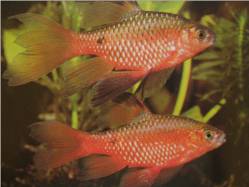
Diet: Worms, crustaceans, insects, dried food, plant matter
Water: fairly soft and around neutral
Breeding: Egg layers
The Rosy Barb has been an extremely popular aquarium fish for the last hundred or so years, and is ideal for the beginner. The body of the Rosy Barb is stocky, and the female is somewhat stouter than the male. In the wild it can grow to 5.5″ (14cm), however in the home aquarium it is unlikely to be larger than 3″ (7.5cm).
The back of the Rosy Barb is iridescent olive-green, and the belly is silvery, sometimes with a reddish tinge. The flanks of the Rosy Barb are reddish with silvery iridescence, becoming brilliant red at spawning time.
The male Rosy Barb has pink fins, and the tip of the dorsal fin is black. The female’s fins are almost colourless, and the dorsal fin has only a darkish tinge.
The Rosy Barb is a very undemanding fish, which prefers to have an aquarium with subdued lighting, which can be achieved by having a few floating plants at the surface. The substrate of the aquarium should be soft sand, because Rosy Barbs like to burrow.
It is recommended to keep at least five Rosy Barbs together, as they like to shoal. It is also advisable to keep at least two females for each male, to ensure the females do not get harassed too much.
At breeding time, the Rosy Barbs will drive vigorously, before the eggs are laid amongst the plants. After twenty four hours the eggs will hatch, and the fry will live for a few days on the contents of the yolk-sac before becoming free swimming. The eggs and fry should be protected from the parents, as Rosy Barbs will eat their own young.