
Angelfish
Genus name: Pterophyllum Scalare
Distribution: South America: Amazon river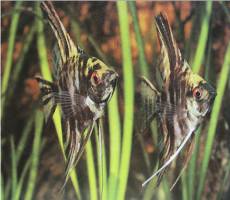
Length: up to 6″ (15cm)
Water Temperature: 72-86F (22-30C)
Diet: Worms, small crustaceans, dried food, insects, plant matter
Water: preferably soft water, but can live in medium-hard water
Breeding: egg layers
One of the most popular of all tropical aquarium fishes, the Angelfish was introduced to the aquarium in the early part of the 20th century.
The Angelfish is part of the Cichlid family, and their natural colour is silvery with three brownish vertical stripes, however years of selective breeding have resulted in a huge variety of different colours and features, from the Gold Pearlscale Angelfish to the Halfblack Veil Angelfish.
Angelfish are piscivores, which means they eat other fish. In most community aquariums they live very peacefully with the other inhabitants, but be aware that they may eat a small fish like a neon tetra that swims by at the top of the tank.
Angelfish a re easy to keep, and easy to breed. Make sure the aquarium is large enough, with plenty of depth, with plants around the edges, giving them plenty of room to swim.
If you wish to breed them, you could buy a pair of breeding Angelfish, or alternatively buy 6 healthy-looking specimens and allow them to pair off themselves. Angelfish form long-term relationships, and once forged, they are not easily broken.
Angelfish reach sexual maturity when they are between six and twelve months old. When they are ready, the female will lay her eggs on a flat surface, it may be a broad leaf, or a flat piece of slate. After she has laid her eggs, the male Angelfish will come along and fertilise them. They will continue until they have laid anywhere from 100-600 eggs.
The pair will now spend the next few days swimming very close and fanning their eggs with their lateral fins to keep the water circulation up. For the first week after hatching, the baby Angelfish (fry), remain attached to the egg and feed off the remains of the yolk. After one week they start swimming freely, and the parents continue to watch out for them.
Don’t be alarmed though if you see one of the adult Angelfish put a baby in its mouth, it is only cleaning it, and will spit it out shortly!